Reframing Requirements to Simplify Content Architecture
At Oracle, I discovered that the custom tool we had built wasn’t necessary to meet the underlying business requirements. By separating user needs from the existing solution, I determined that nearly all required capabilities could be supported through our standard authoring ecosystem.
A custom tool designed to help customers find relevant content faster had resulted in an unscalable architecture that lacked critical functionality. A single publication could expand into hundreds, creating significant maintenance overhead that was compounded by limited bulk-management capabilities. The architecture also failed to support common use cases such as versioned products and content reuse. Usability and reliability issues drove some writers to develop content in wikis, moving it into the tool only for release, while trust had eroded to the point that teams refused to onboard new writers.
The Challenge
The organization had invested in a custom tool to support long-form, personalized articles. However, when I examined how writers were actually working, I found there were no clear standards guiding content creation.
As a result:
Writers lacked a shared definition of what an “article” was.
Content was inconsistently structured, limiting reuse.
Personalization was difficult to implement and often abandoned.
The CMS architecture required significant manual effort to maintain.
More critically, the custom solution duplicated capabilities already available in DITA, adding unnecessary complexity without delivering value.
My Role
I led the definition of content architecture standards and partnered with product and engineering teams to evaluate and realign the underlying CMS approach.
My Approach
1. Diagnosed the root cause: architecture, not adoption
While the initial assumption was low adoption of the tool, I identified a deeper issue:
Lack of content standards.
Misalignment between tooling and writer workflows.
Over-engineered architecture duplicating existing capabilities.
This reframed the problem from a training issue to a systems design issue.
2. Defined a scalable content architecture
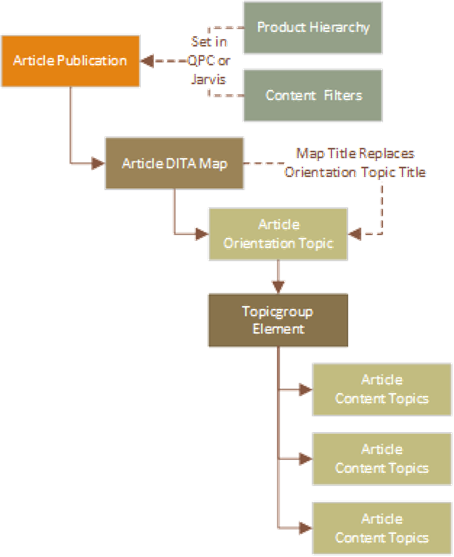
I established a clear, topic-based content model:
Defined what constitutes an article and how it should be structured.
Introduced reusable components to support modular authoring.
Created guidance for structuring content to enable reuse and flexibility.
3. Introduced taxonomy for personalization
To support consistent personalization, I completed these tasks:
Defined key metadata dimensions (audience, environment, configuration).
Partnered with product teams to align on controlled vocabulary.
Ensured taxonomy could be applied consistently across content.
4. Simplified the system by aligning to DITA
Rather than adding more layers to the custom solution, I proposed a strategic shift:
Migrate article content into the existing DITA-based authoring system.
Retire the custom tool.
Leverage native DITA capabilities (e.g., chunking, navigation).
This approach reduced duplication, aligned with existing workflows, and improved scalability.
5. Built alignment through clear tradeoffs
To gain stakeholder support, I:
Mapped the proposed solution to existing DITA capabilities.
Demonstrated how it simplified workflows for writers.
Clearly articulated tradeoffs between customization and scalability.
Key Tradeoff
Rather than continuing to invest in a highly flexible custom-built solution, I recommended aligning article creation to our existing DITA-based system.
This meant giving up some degree of customization and edge-case flexibility in favor of:
Standardization across content types.
Reduced system complexity.
Alignment with existing writer workflows.
While the custom tool allowed for tailored experiences, it introduced duplication, increased maintenance overhead, and limited scalability.
By prioritizing simplicity and reuse over customization, we created a more sustainable foundation that could scale across teams and support consistent personalization.
The Impact
Established a clear, standardized content architecture for long-form content.
Enabled consistent, scalable personalization through structured taxonomy.
Reduced cognitive load for writers by aligning with familiar workflows.
Built strong cross-functional alignment around retiring the custom tool.
Positioned the organization for more efficient, scalable content management.
What This Work Demonstrates
Deep information architecture and content modeling expertise.
Ability to identify and resolve systemic complexity.
Strong technical judgment in build vs. reuse decisions.
Cross-functional influence across product and engineering.
Designing for scalability by simplifying, not adding systems.